
Jacob Stangerup R.S.V.P. Salvator Mundi
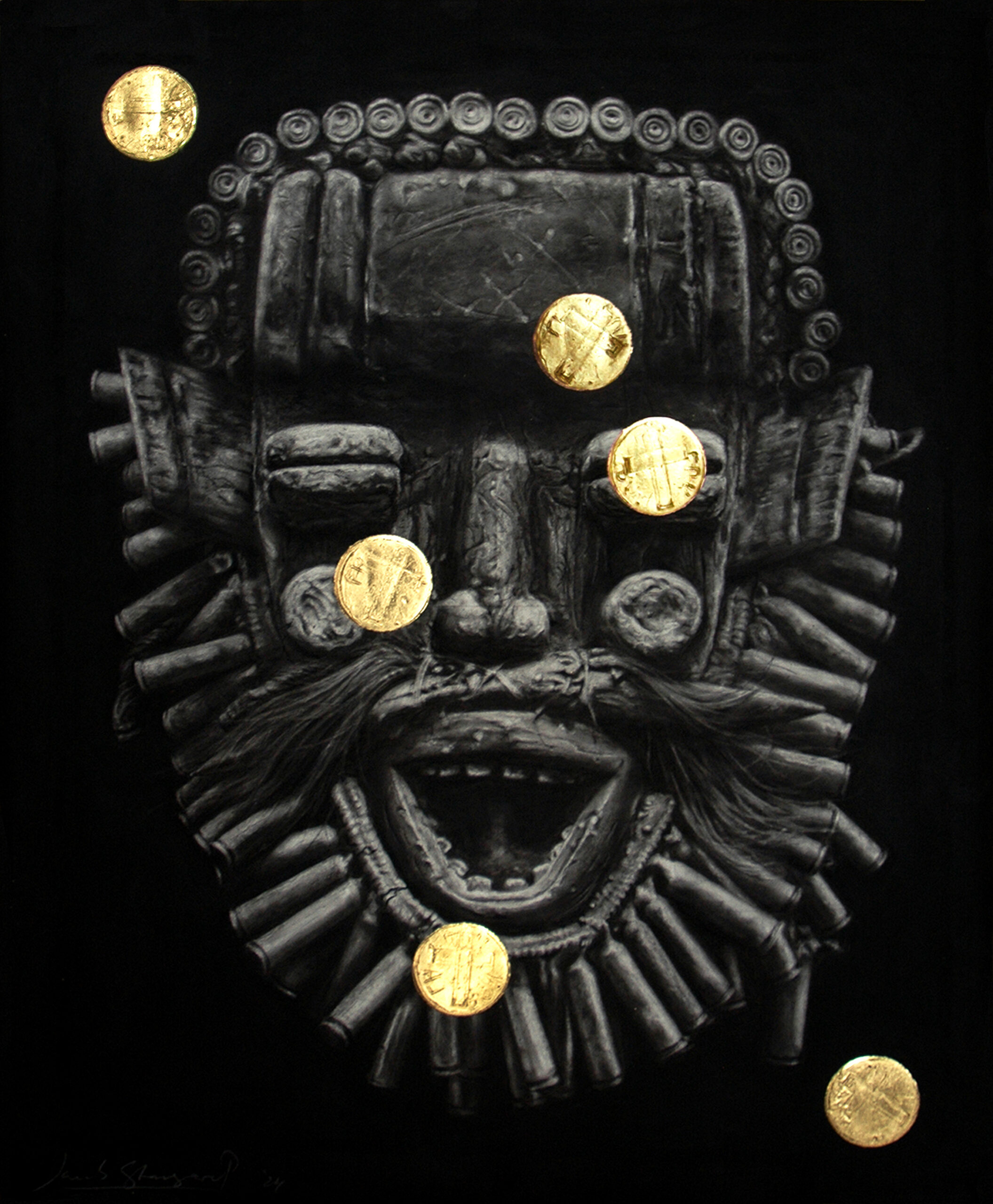
The exhibition is neither a political crusade nor a sermon in a religious sense as such, but a statement that we find ourselves in an exceptionally challenging time. In the exhibition, the works unfold as a form of dialogue through the juxtaposition of diverse visual elements and the artist’s own hybrid reproductions of prominent works or other visual tropes from art and cultural history.
In a central work, we meet an angel hovering over a dilapidated structure made of old driftwood. An original and battered terracotta maquette by Gian Lorenzo Bernini served as the model for the angel in the work, which Stangerup drew in charcoal and subsequently developed into a raw halftone pattern. The halftone drawing was then executed in steel. The wooden plank construction, over which the angel hovers, was created by Stangerup based on an original drawing of a raft, which was part of the account of a shipwreck – the frigate Medusa – in 1816.
A series of cross-like works – which at first glance appear to be old planks quickly and desperately pieced together as a statement on a potentially imminent or already committed atrocity – run throughout the exhibition. Each cross is made of steel and painted with fragments of graphic symbols such as Star of Life, Red Cross, Green Cross, Extinct, and Danger, known from emergency services and relief organizations, or used as hazard symbols in both industrial contexts and civil protests.
Large bronze coins are mounted on the front. The coins are a further development of the concept of emergency money – jeton de nécessité or Notgeld – which, in the aftermath of World War I, was used as a substitute for official currency. Emergency money could, among other things, function as actual currency or, with a specific description of a given coin’s value, be used to acquire grocery items such as meat or bread. In Stangerup’s work, the coins become symbols of hope, doubt, and prayer, featuring roughly engraved titles of literature and poetry, mental states and psychological analyses, as well as natural phenomena and apocalyptic prophecies.
In a suite of paintings under the title Temptation, Stangerup paraphrases the motif The Temptation of Saint Anthony, a frequently depicted subject in religious iconography. Throughout art history, artists have used this narrative to depict the grotesque, demonic entities and erotic visions to which Saint Anthony was subjected – from Hieronymus Bosch, Matthias Grünewald, and Michelangelo in the Renaissance to Otto Dix, Salvador Dalí, and Max Ernst in later eras. Stangerup’s work is not a direct reference to the monk Saint Anthony, but rather a depiction of various ancient sculptures in dialogue with a surreal botanical phenomenon that, with probing tentacles and alluring openings, seems intent on seducing and leading the viewer into ruin.
Although the symbols and textual and visual references from various art historical époques point in a certain apocalyptic direction, the work presents itself as an ongoing collage that remains open to additions, rearrangements, and changes. And hidden within this fatalistic, perhaps melodramatic scenario, there is hope. Hope for tomorrow. A hope that today’s pain, challenges, and conflicts will be understood, resolved, and seen through the eyes of tomorrow.
Jacob Stangerup (b. 1971) lives and works in Copenhagen. Was in 1996-2000 in apprenticeship with the sculptor Jørgen Haugen Sørensen in Pietrasanta, Italy. Jacob Stangerup has previously exhibited at e.g., Nivaagaards Malerisamling, Kunstforeningen Gl. Strand and Magasin 3 Museum of Contemporary Art in Stockholm.