
Afterimages
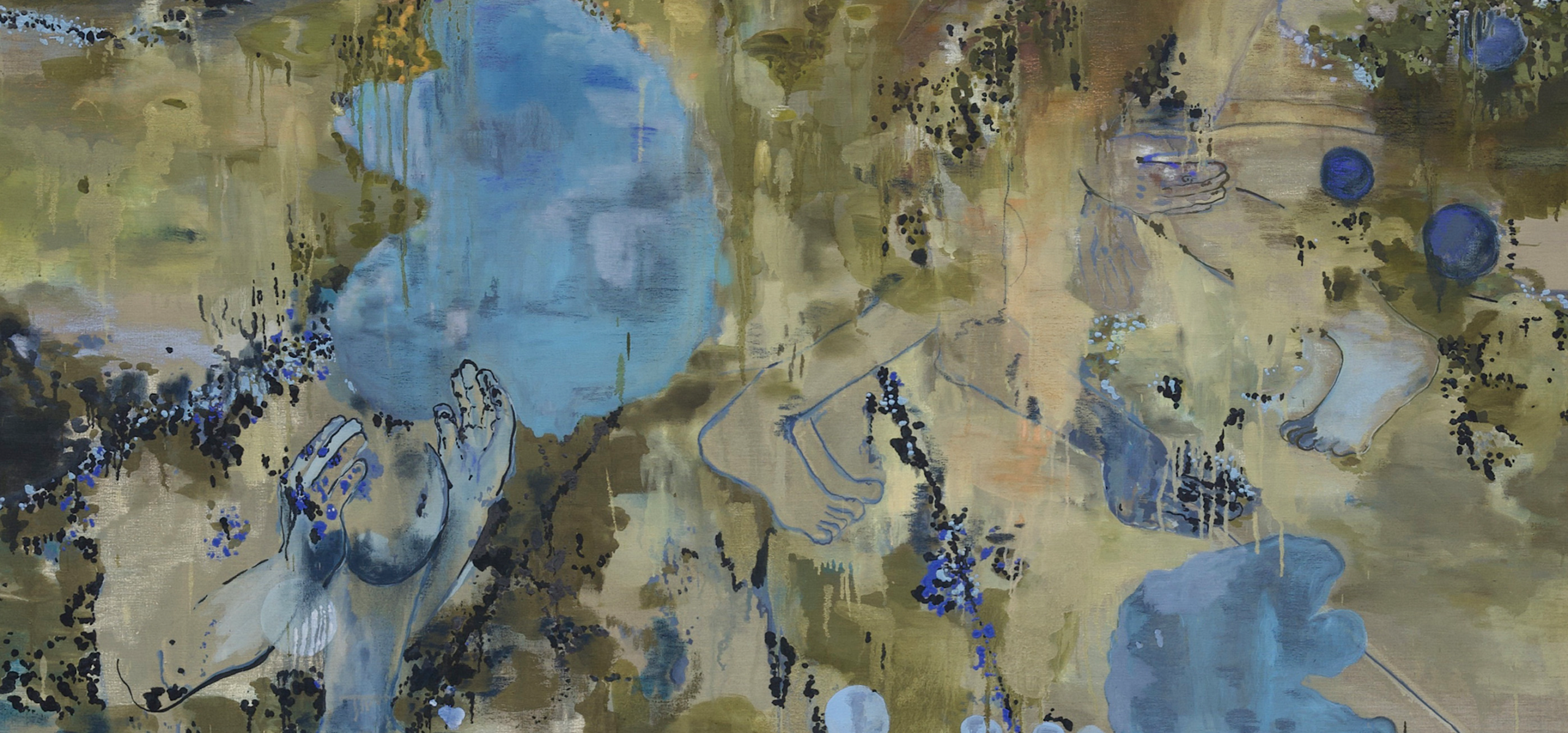
Drawing inspiration from the paintings and frescoes of the Italian masters, Jonas Kolecki creates large-scale collages from imagery found in newspapers and online media. Transferred onto wooden panels and canvases, these images take on the appearance of weathered frescoes, evoking the gradual erosion of images and the passage of time. His works suggest that everything around us is subject to decay, leaving behind fragments for future generations to encounter and reinterpret. This archaeology of the present extends into Kolecki’s video work Cleaning the Pool (2016). His practice often begins with walking and wandering, allowing overlooked places, objects, and chance encounters to come into view and reveal themselves.
Traces of the past also resonate throughout Amanda Seibæk’s practice, which explores forms of communication that precede and exceed human language. Long before the emergence of human language, the world was already alive with communication: vibrations, frequencies, flashes of light and collective movements. Seibæk reflects on how many of these forms of communication are now under threat or disappearing. Fireflies, for instance, face growing pressures from habitat destruction, artificial light, noise pollution, and toxic chemicals. Rather than depicting animals directly, Seibæk explores how painting might register the vibration of life itself. Her works evoke presence through movement, frequency, and accumulated marks, giving form to modes of life and communication that resist direct representation.
Oscar Eriksson Furunes draws on imagery from queer archives, including the archive of LGBT+ Denmark, and particularly the photographic archive of Axel Axgil, a co-founder of the organization and a prominent queer activist. Through installations that rework historical materials, Furunes incorporates personal references, gestures, and codes, approaching the archive through a queer perspective. Alongside works based on archival imagery, a new series presents a fragmented portrait of Daniel, a close friend of the artist who works as a dancer and choreographer. Moving between intimate portraiture and historical documentation, the works explore the intersections of personal and collective histories, and the ways in which individual lives are situated within broader public narratives.
Across Afterimages, images, gestures, and traces emerge, shift, and fade. Whether working with found imagery, the fleeting signals of the natural world, or the fragments of queer histories, the artists attend to what remains, what is overlooked, and what might otherwise be lost. The exhibition considers how meaning is carried across time, not as a fixed record, but as something continually transformed through acts of looking, remembering, and reinterpretation.
Oscar Eriksson Furunes (b. 1991) is a Norwegian-Swedish artist and architect. He graduated from Malmö Art Academy in 2023 and works with historical material, which he supplements with personal references, gestures, and codes. Thematically, he explores the boundaries and overlaps between what we perceive as personal, individual history and collective, public history. In 2026, he presented his solo show GLITRA at Møstings Hus. Other institutional shows include Photographic Centre Peri, Finland; Kohta taidehalli, Finland; Malmö Art Museum, Sweden; Inside-Out Art Museum, China; Kunstnernes Hus, Norway, among others. His work can be found in public collections such as Malmö Art Museum and Trondheim Art Museum.
Jonas Kolecki (b. 1994) is a filmmaker, painter, and collagist whose multidisciplinary practice centers on time as both a tool and a subject. His work explores themes of ephemerality, decay, and the human impact on landscapes—physical and conceptual alike. He studied at the Academy of Fine Arts Munich in Munich, Germany, where he was part of the class of Olaf Nicolai. His work has been exhibited at institutions including Fondazione Antonio Dalle Nogare, Bolzano, Italy (2020); Fondazione Centro Arti Visive di Pietrasanta, Pietrasanta, Italy (2018); and Kunstarkaden München, Munich, Germany (2023). His works are held in collections including the Muri-Gries Monastery, Bolzano, and the Barth Collection, Bressanone, Italy.
Amanda Seibæk (b. 1994) is a painter and printmaker whose practice centres on themes inspired by scientific explanations of natural phenomena. She is inspired by Maggie Nelsons autotheorical works, connecting multiple fields of knowledge, never deeming any irrelevant for her explorations. Seibæk studied at Glasgow School of Art. Her work is held in collections including SWG3, Scotland; The King’s Foundation, Dumphries House, United Kingdom; the Simon Nixon Collection, United Kingdom.